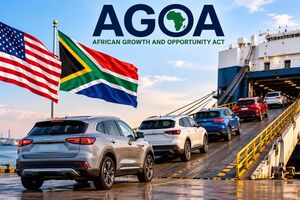
So says the National Association of Automotive Component and Allied Manufacturers (NAACAM) CEO Renai Moothila about the announcement by the United States (US) government of its intention to end South Africa’s access to the African Growth and Opportunity Act (AGOA) from 1 January 2027.
Following the introduction of Section 232 tariffs, South Africa’s automotive exports to the US fell by 29% from R28.67bn in 2024 to R20.43bn in 2025. Direct component exports fell by 12.8% to R3.86bn. Light vehicle exports fell by 31.7% to R16.57bn, affecting not only domestic original equipment manufacturers (OEMs) but also their entire domestic supply chain.
From January, these products will also pay the standard US import duty, typically around 2.5% for automotive products. This widens the gap with competing producers in the United Kingdom (UK), European Union (EU), Japan and Korea, which have negotiated lower automotive tariffs.
“The direct cost of losing AGOA is modest next to existing tariff measures, but in a globally competitive industry every percentage point counts,” Renai says.
The loss of AGOA comes on top of existing pressures on the component sector. NAACAM has recorded 15 company closures and more than 7 500 gross job losses among component manufacturers over the past three years. These were driven in part by declining local content, production cuts at some vehicle manufacturers, falling exports, including to the US, and rising operational costs.
AGOA is one more factor weighing on the competitiveness of a sector that is already under strain.
NAACAM believes the strongest buffer against external trade shocks lies in South Africa’s own market. The South African Automotive Masterplan (SAAM) 2035 set a goal of 48.2% local content by 2025, worth around R101bn. Instead, local content stood at 39% in 2025, about the same as the 38.7% recorded in 2015, when local content was worth R53bn.
“South Africa cannot control the trade policies of export markets, but it can take decisive action to strengthen its own automotive manufacturing base. Growing domestically produced vehicle sales to South African consumers and significantly increasing local content are essential to supporting component manufacturers, protecting employment and reducing our vulnerability to external trade shocks,” he says. “The current policy review is an opportunity to put in place defined localisation measures that deliver this, and support manufacturers seeking to diversify their export markets.”
NAACAM urges the respective governments to continue engagements and has long called for a mutually beneficial trade agreement that covers trade, investment, skills and technology transfer. Such an agreement should address the Section 232 tariffs on vehicles and components, and it is now more urgent than ever.
The commercial ties between the two automotive industries remain relevant and run in both directions. The US is South Africa’s fourth-largest automotive trading partner, with two-way trade of R44bn in 2025. South Africa imported R20.6bn of US-made components in 2025, more than five times what it exported to the US, and several US-headquartered companies manufacture components in South Africa.