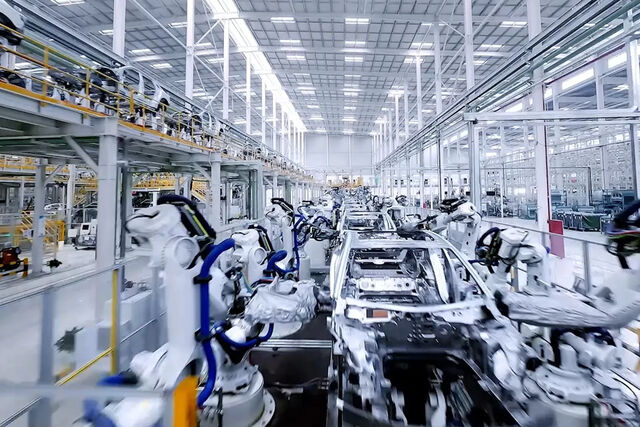
Chinese carmakers lifted their share of South Africa’s passenger car market to 16.8% in 2025, from 11.2% a year earlier, according to data from the Automotive Business Council (naamsa). The Cars.co.za Industry Report puts their share at about 22% in the second quarter of 2026.
From weak petrol cars to electric strength:
For decades, Chinese brands did not lead. Foreign manufacturers entered through joint ventures with state-run partners in exchange for market access.
Zhao Xiaoqing, writing in the Journal of Zhejiang University (Humanities and Social Sciences) in 2013, judged the strategy a failure. He found that foreign brands dominated the market and the core technology stayed largely foreign. He blamed poor government coordination, a scattered industrial structure and the lack of public research institutes, and contrasted China’s car industry with Korea’s, which moved on to develop its own vehicles.
Scott Kennedy of the Centre for Strategic and International Studies (CSIS), a Washington think tank, gives a more mixed account. He accepts that the required joint ventures transferred substantial technology from the mid-1990s, but says recent progress was led by independent private firms such as BYD, Geely and Great Wall Motors. He argues that the move to electric motors lowered the technology threshold, which let start-ups from the information technology sector enter the market.
The shift in market share has been large. Rhodium Group, a New York research firm, reports that Western carmakers’ share of the Chinese market fell from 62% in 2020 to 35% in 2025.
Labour is a factor, but not the main one:
If cheap labour were the main reason, it should have helped Chinese carmakers during the petrol car era too.
Rhodium’s February 2026 report compares BYD, Geely and Leapmotor with Tesla, with all of them building cars in China. It notes that China offers a deep electric vehicle ecosystem, widespread subsidies and lower wages, but says this does not fully explain why Western carmakers producing locally in China still struggle on price, even though their supply chains are largely localised.
Where lower labour costs do show up is in engineering and overheads. Rhodium puts BYD’s administration and R&D spending at about R38 327 ($2 302) per vehicle, against about R66 947 ($4 021) for Tesla.
It says the gap comes largely from cheaper China-based R&D, where large engineering teams cost far less than in the United States (US) or in the European Union (EU). The Kiel Institute, a German research body, adds that producing electric cars in the EU costs significantly more because of higher energy and material prices and, above all, higher labour costs.
Where the cost gap comes from:
Rhodium estimates BYD’s cost advantage over Tesla at roughly R78 252 ($4 700) per vehicle, with vertical integration and lower overheads together accounting for at least three quarters of it.
BYD makes about 80% of its Tier 1 components in-house, against 37% for Tesla, which Rhodium estimates avoids about R39 442 ($2 369) per vehicle in supplier mark-ups.
State support is large, but how much of the gap?
The sources differ here, partly because they measure different forms of support.
Scott Kennedy calculates that Chinese government support to the electric vehicle sector totalled $230.9 billion from 2009 to 2023, covering buyer rebates, tax exemptions, charging infrastructure, R&D and procurement. He calls that figure conservative, because it excludes cheap land, electricity and credit.
He also sets out the opposing view. Defenders of China’s EV industry argue that while government subsidies played a significant role in its early growth, support has declined substantially over time. Subsidies accounted for more than 40% of sales in the industry’s early years but had fallen to 11.4% by 2023, with average support per vehicle dropping to just under R79 917 ($4 800). They also point out that this is lower than the R124 870 ($7 500) credit available under the US Inflation Reduction Act.
Other governments back their carmakers too:
Is China alone in this? The research says no. A Meiji Gakuin University paper notes that Japan used foreign currency quotas and tariffs on vehicles and parts to protect its industry.
South Korea went further. A journal paper says the mid-1960s Automobile Industry Protection Law prohibited imports of completed cars, and that a 1974 plan offered a 50% cut in excise tax and a 67% cut in consumption tax. An MIT Japan Program working paper adds that when Kia collapsed in 1997, loans from the state-run Korea Development Bank were converted to equity. This means the state-run bank wiped out the money Kia owed it as a loan and instead traded that debt for ownership shares (stock) in the company
Europe’s support is a patchwork. Bruegel’s September 2026 policy brief lists 2026 consumer subsidies including €550 million in Germany, €8 billion in total in France, €600 million in Italy and €400 million in Spain.
At EU level, a €1.8 billion Battery Booster fund provides interest-free loans. Bruegel describes the arrangement as an implicit pact in which the EU shields producers from external pressure while consumers and taxpayers bear the cost.
The South African picture:
South Africa supports its own car industry as well. A May 2026 note from Stellenbosch University’s Bureau for Economic Research says National Treasury estimated automotive incentives at R41.2 billion in tax expenditure in 2023/24, against R426 million for textiles and clothing.
The same note finds lower prices at the entry level. A Chery Tiggo Cross costs R111 000 (26%) less than a Toyota Corolla Cross, and a Suzuki Swift R44 000 (16%) less than a VW Polo Vivo.
It also points to local costs. Load shedding, port and rail inefficiencies and labour disruptions act like a hidden production tax, and 2025 production of 610 405 vehicles was 56% below the Automotive Master Plan target. The note concludes that imports from China, India and Thailand do not appear to be the root cause of the sector’s problems but have exposed deeper structural weaknesses.
What the research supports:
Labour costs matter, but mainly in engineering and overheads. State support is real, large and long running. Rhodium puts its direct share of the BYD and Tesla gap at about 5%, while CSIS and the Kiel Institute stress its scale. Japan, South Korea, European governments and South Africa have all backed their own car industries too.
Photo: BYD Global