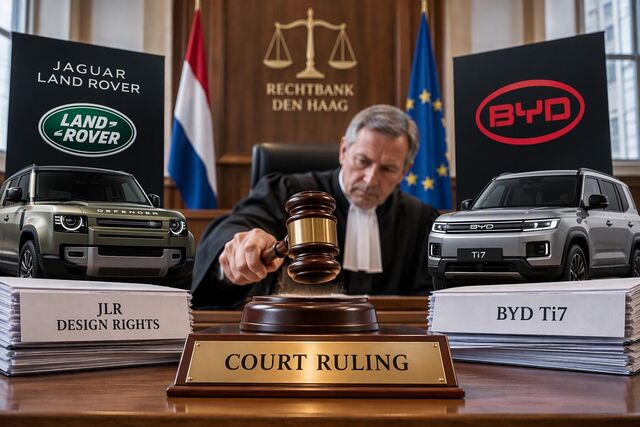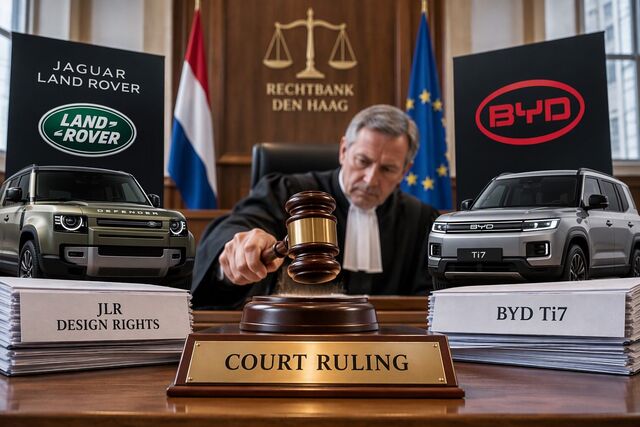
The ruling, handed down by the District Court of The Hague on 20 November 2026, prohibits BYD from importing, manufacturing, marketing or selling the Ti7 within the European Union (EU). The judgment marks a major development in a dispute that has been closely watched across the global automotive industry since JLR first launched legal action over the vehicle's design.
At the heart of the case was JLR's claim that the Ti7 bears an unacceptably close resemblance to the latest-generation Defender. The British manufacturer argued that several distinctive design elements of its iconic off roader had been replicated in BYD's SUV.
In its decision, the court agreed that the Ti7 infringes JLR's registered EU design rights for the Defender. The judge pointed to a number of shared visual characteristics, including the vehicle's rounded shoulders, wheel-arch cut-outs, continuous side window line, distinctive side panel treatment and overall silhouette. According to the ruling, these combined features create a similar overall impression to that of the Defender.
As a result, BYD's European operations have been ordered to cease importing, producing, offering for sale or otherwise commercialising the Ti7 within the EU. The order also extends to future production at the company's manufacturing facility in Hungary.
The court further imposed substantial penalties should BYD fail to comply. The ruling provides for fines of R1.9 million (€100 000) per day, or R480 000 (€25 000) per vehicle, up to a maximum of R192 million (€10 million).
While the judgment represents a notable victory for JLR, the court stopped short of granting all the remedies sought by the company. The Dutch court declined jurisdiction over BYD's UK business, meaning the ruling has no direct effect on potential sales of the Ti7 in Britain. The court also rejected requests relating to website rectifications and access to previously seized documents.
The latest decision follows an earlier procedural dispute between the companies concerning evidence obtained during investigations linked to the case. Those proceedings centred on document handling and evidentiary matters rather than the core design-rights allegations that formed the basis of the latest judgment.
Importantly, the ruling was issued as a preliminary injunction, meaning further legal proceedings on the merits of the case are still expected. The court has given JLR six months to commence substantive proceedings should it wish to pursue the matter further.
For JLR, the outcome reinforces the value of intellectual property protection in an increasingly competitive automotive landscape. The Defender has become one of the company's most recognisable and commercially successful models, making the protection of its distinctive design a strategic priority.
For BYD, the ruling represents a setback in Europe, where the Chinese manufacturer has been aggressively expanding its presence. Whether the company chooses to appeal the decision remains to be seen, but for now the Ti7's path into the European Union has effectively been blocked.