LPGSA: AutoGas Workshop
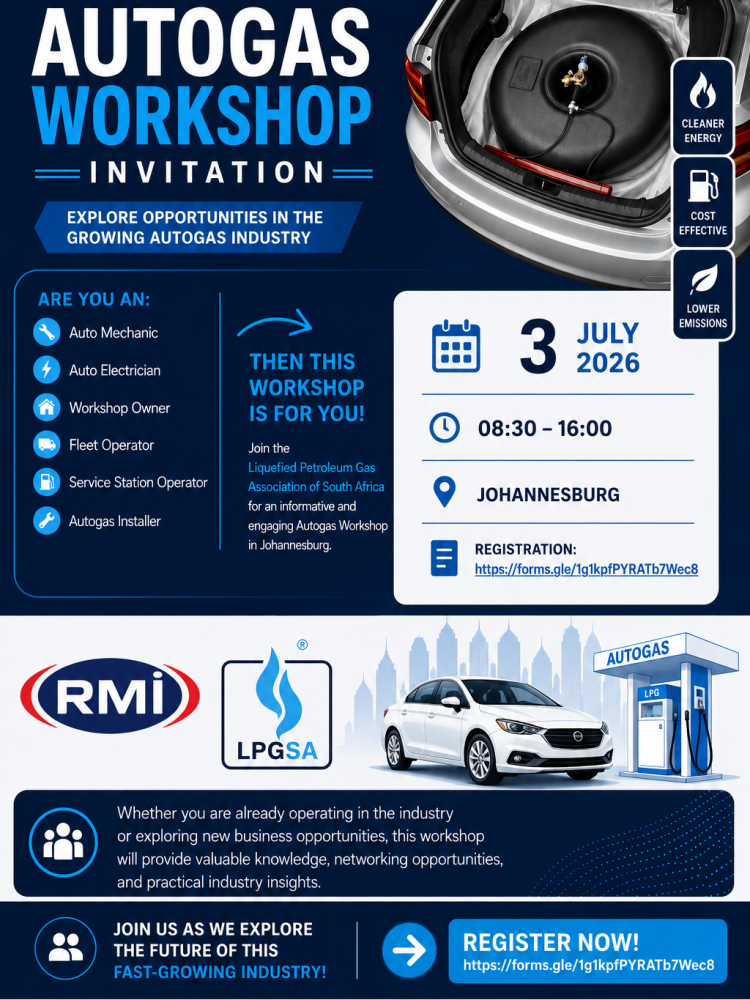
The Liquefied Petroleum Gas Safety Association of South Africa (LPGSA), in association with the Retail Motor Industry Organisation (RMI), will host South Africa's inaugural AutoGas Workshop on 3 July 2026 at the Indaba Hotel, Fourways, providing key insights into one of South Africa's emerging alternative fuel markets.
South Africa’s transport sector is a significant and growing contributor to national greenhouse gas (GHG) emissions and urban air pollution. As economic activity, urbanisation, and vehicle ownership increase, emissions from transport—particularly road transport—continue to rise, creating serious environmental, public health, and energy security challenges. The Department of Forestry, Fisheries and the Environment (DFFE) has identified the road transport sector as the third-largest contributor to GHG emissions in the country. Furthermore, air pollution is estimated to impose a substantial economic burden, costing approximately 4% of South Africa’s GDP, underscoring the urgent need for cleaner, more sustainable transport solutions.
Autogas, or liquefied petroleum gas (LPG) used as a vehicle fuel, presents a practical and lower-emission alternative to conventional fuels such as petrol and diesel. Its adoption can play a transitional role in reducing emissions in South Africa’s transport sector.
Emission Reduction Benefits
Autogas offers several environmental advantages:
- Lower Greenhouse Gas Emissions
- LPG has a lower carbon content than petrol and diesel, resulting in reduced CO₂ emissions. [afdc.energy.gov]
- Studies show CO₂ reductions of around 8–13% compared to gasoline vehicles under real-world conditions. [afdc.energy.gov], [mdpi.com]
- Reduced Air Pollutants
- Autogas produces significantly less harmful pollutants such as:
- Nitrogen oxides (NOx)
- Particulate matter (PM)
- It can achieve up to 98% lower NOx emissions than diesel and around 90% less particulate matter than petrol vehicles. [worldliquidgas.org]
- Cleaner Combustion
- LPG burns more completely than petrol or diesel, leading to:
- Lower carbon monoxide emissions
- Reduced formation of urban smog
- It also results in lower engine deposits, improving efficiency and reducing maintenance impacts. [businesstech.co.za]
- Improved Urban Air Quality
- Lower NOx and PM emissions directly improve air quality in dense urban environments, where transport emissions are concentrated.
- This contributes to better public health outcomes, particularly in high-traffic areas.
About Autogas workshop.
The use of Autogas vehicles in South Africa is steadily increasing; however, adoption remains relatively low compared to other developing countries. To help accelerate uptake, the LPG Association of South Africa (LPGSA), in partnership with the Retail Motor Industry Organisation (RMI) and supported by the World Liquid Gas Association (WLGA), will host an Autogas workshop.
The workshop will provide insight into global Autogas market trends, including case studies from countries such as Poland and India where Autogas adoption is well established. The sessions will also examine South Africa’s current regulatory framework for Autogas, highlighting both opportunities and constraints. In addition, Autogas-converted vehicles and related technologies will be showcased.
The primary objective of the workshop is to develop practical strategies and an advocacy plan to position Autogas as a key component of South Africa’s transport sector decarbonisation efforts
“LPG is a viable and proven option for transportation, available today and ready for tomorrow.”
Secure your spot by registering here:
https://forms.gle/1g1kpfPYRATb7Wec8