VWGA completes solar panel project at Component Plant
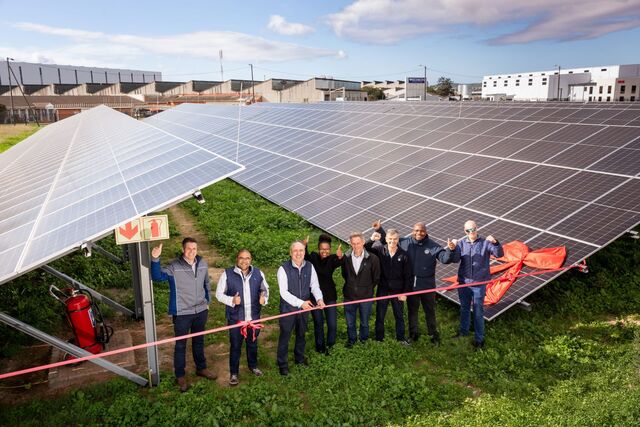
Reinforcing their commitment to sustainability and renewable energy, Volkswagen Group Africa (VWGA) has completed a photovoltaic solar panel project at their Component Plant in Kariega, Eastern Cape.
Share with friends
The project, completed in June 2026, comprises 1 410 solar panels mounted on the roofs of the building and its car park, as well as a ground-mounted portion. This facility has a capacity of about 0,88MWp, and is the latest addition to VWGA’s renewable energy projects.
VWGA previously completed a multi-phase solar panel installation over their employee car park, which included 9 294 panels with a capacity of 5.2MWp, capable of producing 7 125MWh annually. Additionally, similar solar panel projects were completed on the roof of the Final Assembly building (1,7MWp) and the engine plant (1MWp).
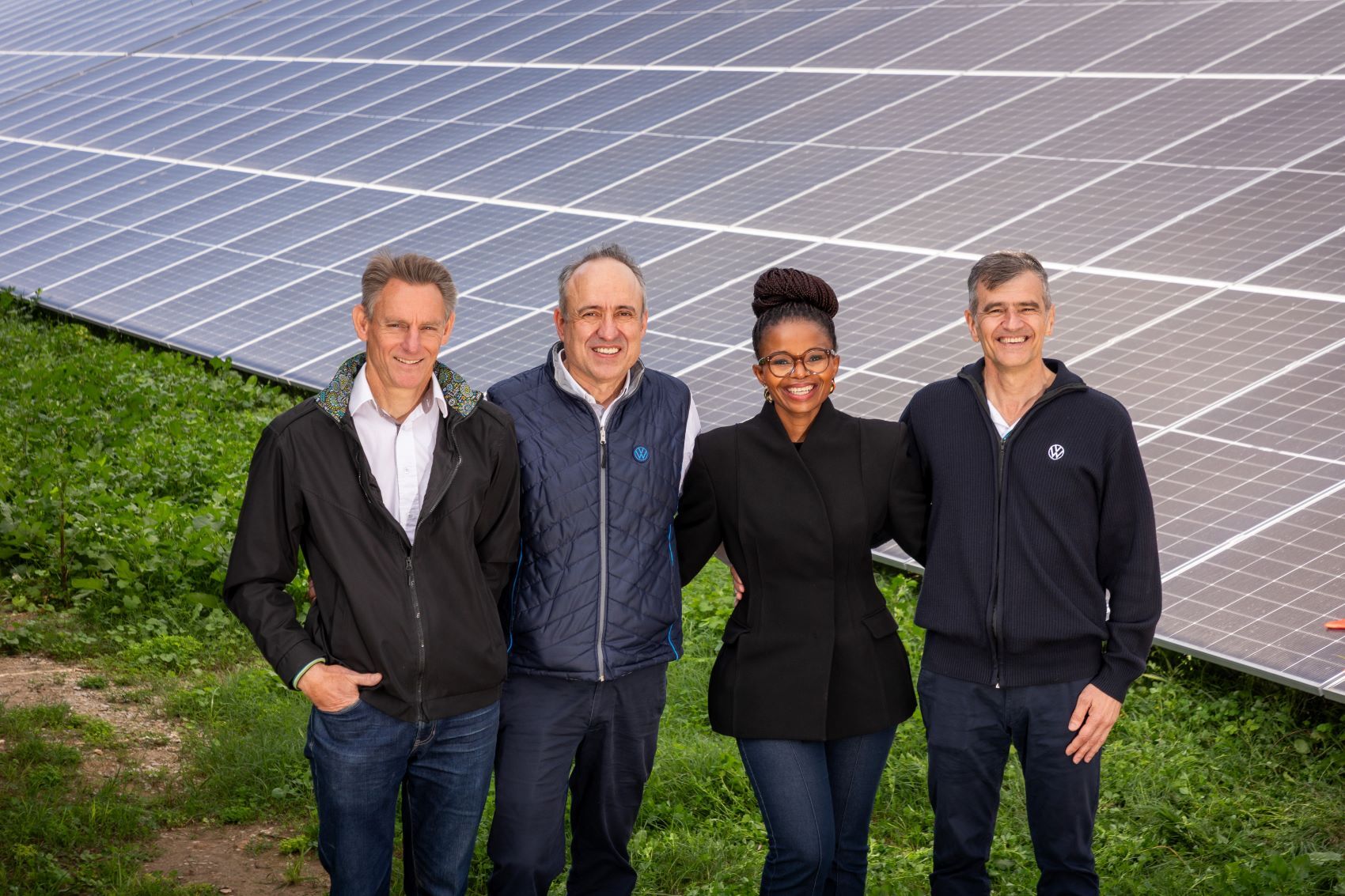
Seen here are Mike Petrie, Ulrich Schwabe, Ntsapokazi Ningiza and Pano Mantatzis.
These projects form part of a long-term sustainability roadmap towards achieving carbon-neutral electricity in VWGA’s production operations. In 2025, Plant Kariega relied on green energy sources for 40% of its energy requirements.
“We have made significant strides in recent years towards fully sustainable manufacturing,” says Ulrich Schwabe, Production Director at Volkswagen Group Africa. “As a company we remain committed towards practices that are responsible and sustainable, and our work in increasing our green footprint is never done.”
Also read our previous reporting on Volkswagen’s solar project:
The first Volkswagen Tengo destined for an African customer rolled off the production line at Plant Kariega on 9 November 2026, making history in more ways than one.
The fully electric Lepas L6 EV can now be preordered at the brand’s 35 operational dealerships in South Africa. Customers who preorder receive a complimentary charging package valued at R34 053.
Energy security, electrification, grid infrastructure and sustainable transport take centre stage at COP31 in Antalya, Türkiye, as the climate conference devotes a full day to energy and transport. Africa enters that conversation with a plan of its own: the African Union’s (AU) Continental Framework on Electric Mobility (eMobility).
As electric and plug-in hybrid vehicles become more common in South Africa, dealerships and workshops face new safety challenges. In this article, sponsored by Bright Focus, we look at complete scenario surrounding the damaged high-voltage battery packs can present and the solution.