
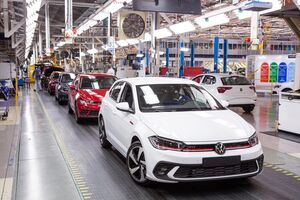
Volkswagen Group Africa sets new monthly production record
In the latest of a series of milestone achievements, Volkswagen Group Africa (VWGA) has set a new record for the number of vehicles built in one month.
- Industry News
- 20 August 2026
Mercedes-Benz recently announced from its Stuttgart headquarters that it will delay its electrification goal by five years and assured investors it would keep sprucing up its combustion engine models.

This made the company the latest one in a growing line of carmakers to flag a weaker-than-expected appetite for battery-powered cars.
The company now expects sales of electrified vehicles, including hybrids, to account for up to 50% of the total by 2030 - five years later than its forecast from 2021, when it aimed to hit the 50% milestone by 2025 with mostly all-electric cars.
While automakers and suppliers are betting big on future demand for electric vehicles, investment in capacity and technology development has outrun actual EV demand, prompting carmakers to readjust production plans.
CEO Ola Kaellenius cautioned towards the end of last year that even in Europe sales would likely not be all-electric by 2030, with battery-powered cars currently making up just 11% of total sales, and 19% including hybrids.
Ola says Mercedes-Benz wanted customers and investors to know it was well-positioned to carry on producing combustion engine cars and was ready to update the technology well into next decade.
Its current plans for updates mean "it is almost like we will have a new line-up in 2027 that will take us well into the 2030s," Ola says.
Shares in the luxury carmaker were up 5.9% following the news, also supported by a R62 billion (three billion euro) share buyback programme unveiled.
Slower economic growth, supply chain bottlenecks and trade tensions between China and both the US and European Union also weighed on Mercedes-Benz's outlook for 2024, the carmaker said, forecasting lower returns on sales across its car and van divisions.

In the latest of a series of milestone achievements, Volkswagen Group Africa (VWGA) has set a new record for the number of vehicles built in one month.
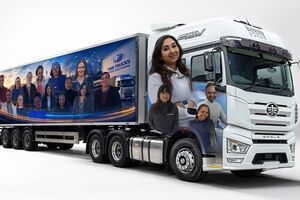
As South Africa celebrates Women’s Month, FAW Trucks Southern Africa is highlighting the changing role of women in the transport and logistics industry and their growing contribution across the sector.
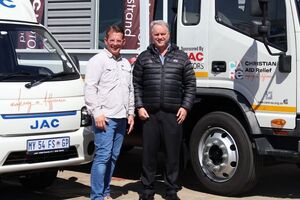
JAC Motors South Africa has strengthened its long-standing partnership with Christian Aid Relief (CARE) by donating two trucks to support the organisation’s humanitarian work.
 Advertisement
 Advertisement
I have bad reflexes. I was once run over by a car being pushed by two guys
Woody Allen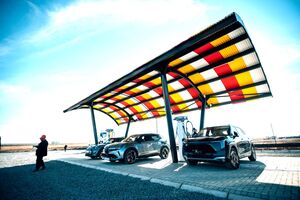
Three months after launching its off-grid, solar-powered electric vehicle (EV) charging network on the N3 corridor, Zero Carbon Charge (CHARGE) has confirmed plans to double charging capacity at both Charge hubs.
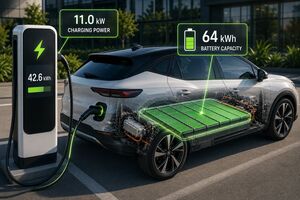
Electric vehicles (EVs) have introduced a whole new vocabulary into motoring. Instead of simply talking about litres of fuel, cylinders and kilometres per tank, motorists are now confronted with kW, kWh, AC, DC, WLTP, regenerative braking and a host of other terms.
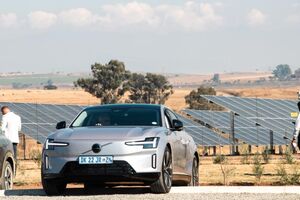
Zero Carbon Charge (CHARGE), which is building a national network of off grid, ultra-fast EV charging stations powered by renewable energy, has welcomed the latest new energy vehicle (NEV) sales figures, saying they confirm a trend it has tracked for several years.